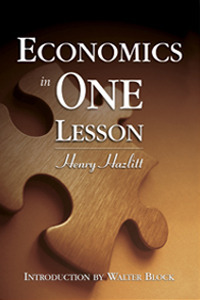
Description
Henry Hazlitt wrote this book following his stint at the New York Times as an editorialist. His hope was to reduce the whole teaching of economics to a few principles and explain them in ways that people would never forget. He relied on some stories by Bastiat and his own impeccable capacity for logical thinking and crystal-clear prose.
He was writing under the influence of Mises himself, of course, but he brought his own special gifts to the project. As just one example, this is the book that made the idea of the "broken window fallacy" so famous.
Written for the non-academic, it has served as the major antidote to fallacies in the popular press, and has appeared in dozens of languages and printings. It's still the quickest way to learn how to think like an economist. And this is why it has been used in the best classrooms for more than sixty years.
Contents:
* Part One: The Lesson
* Part Two: The Lesson Applied
o The Broken Window
o The Blessings of Destruction
o Public Works Mean Taxes
o Taxes Discourage Production
o Credit Diverts Production
o The Curse of Machinery
o Spread-the-Work Schemes
o Disbanding Troops and Bureaucrats
o The Fetish of Full Employment
o Who's "Protected" by Tariffs?
o The Drive for Exports
o "Parity" Prices
o Saving the X Industry
o How the Price System Works
o "Stabilizing" Commodities
o Government Price-Fixing
o Minimum Wage Laws
o Do Unions Really Raise Wages?
o "Enough to Buy Back the Product"
o The Function of Profits
o The Mirage of Inflation
o The Assault on Savings
o The Lesson Restated
This is the book to send to reporters, politicians, pastors, political activists, teachers, or anyone else who needs to know. Many writers have since attempted to beat this book as an introduction, but have never succeeded. Hazlitt's book remains the best. Even if you own this book already, or have several past editions, you will want to have this book as your own as a testament to its place in the world of ideas.
Endorsements
Professor Block explains that it was this book that turned him on to economics as a science. He believes that it is probably the most important economics book ever written in the sense that it offers the greatest hope to educating everyone about the meaning of the science. — Professor Block