Shift Your Thinking
(26 books)

Braiding Sweetgrass
Robin Wall Kimmerer
As a botanist, Robin Wall Kimmerer asks questions of nature with the tools of science.As a member of the Citizen Potawatomi Nation, she embraces indigenous teachings that consider plants and animals to be our oldest teachers.Kimmerer brings these two lenses of knowledge together. Drawing on her life as an indigenous scientist, a mother, and a woman, she shows how other living beings offer us gifts and lessons, even if we've forgotten how to hear their voices.Endorsements"A mesmerizing storyteller with deep compassion and memorable prose." — Publishers Weekly"Anyone interested in natural history, botany, protecting nature, or Native American culture will love it." — Library Journal"Takes us on a journey that is every bit as mythic as it is scientific, as sacred as it is historical, as clever as it is wise." — Elizabeth Gilbert

A Psalm for the Wild-Built
Becky Chambers
It's been centuries since the robots of Panga gained self-awareness and laid down their tools; centuries since they wandered, en masse, into the wilderness, never to be seen again; centuries since they faded into myth and urban legend.One day, the life of a tea monk is upended by the arrival of a robot, there to honor the old promise of checking in. The robot cannot go back until the question of "what do people need?" is answered.But the answer to that question depends on who you ask, and how.They're going to need to ask it a lot.Becky Chambers's new series asks: in a world where people have what they want, does having more matter?EndorsementsIn A Psalm for the Wild-Built, Hugo Award-winner Becky Chambers's delightful new Monk & Robot series gives us hope for the future.

The Practice of Not Thinking
Ryūnosuke Koike
Former monk Ryunosuke Koike shows how, by incorporating simple Zen practices into our daily lives, we can reconnect with our five senses and live in a more peaceful, positive way. When we focus on our senses and learn to re-train our brains and our bodies, we start to eliminate the distracting noise of our minds and the negative thoughts that create anxiety. By following Ryunosuke Koike's practical steps on how to breathe, listen, speak, laugh, love and even sleep in a new way, we can improve our interactions with others, feel less stressed at work and make every day calmer.What if we could learn to look instead of see, listen instead of hear, feel instead of touch? Only by thinking less can we appreciate more.Endorsements'Practical and life-changing ways to get out of our heads and back into really living' — YOU Magazine

A Woman Looking at Men Looking at Women
Siri Hustvedt
A compelling and radical collection of essays on art, feminism, neuroscience, psychology, and philosophy from prize-winning novelist Siri Hustvedt, the acclaimed author of The Blazing World and What I Loved.Siri Hustvedt has always been fascinated by biology and how human perception works. She is a lover of art, the humanities, and the sciences. She is a novelist and a feminist. Her lively, lucid essays in A Woman Looking at Men Looking at Women begin to make some sense of those plural perspectives.Divided into three parts, the first section, “A Woman Looking at Men Looking at Women,” investigates the perceptual and gender biases that affect how we judge art, literature, and the world in general. Among the legendary figures considered are Picasso, De Kooning, Jeff Koons, Louise Bourgeois, Anselm Kiefer, Susan Sontag, Robert Mapplethorpe, the Guerrilla Girls, and Karl Ove Knausgaard.The second part, “The Delusions of Certainty,” is about the age-old mind/body problem that has haunted Western philosophy since the Greeks. Hustvedt explains the relationship between the mental and the physical realms, showing what lies beyond the argument—desire, belief, and the imagination.The final section, “What Are We? Lectures on the Human Condition,” discusses neurological disorders and the mysteries of hysteria. Drawing on research in sociology, neurobiology, history, genetics, statistics, psychology, and psychiatry, this section also contains a profound and powerful consideration of suicide.There has been much talk about building a beautiful bridge across the chasm that separates the sciences and the humanities. At the moment, we have only a wobbly walkway, but Hustvedt is encouraged by the travelers making their way across it in both directions. A Woman Looking at Men Looking at Women is an insightful account of the journeys back and forth.

Man's Search for Meaning
Viktor E Frankl
A prominent Viennese psychiatrist before the war, Viktor Frankl was uniquely able to observe the way that both he and others in Auschwitz coped (or didn't) with the experience. He noticed that it was the men who comforted others and who gave away their last piece of bread who survived the longest — and who offered proof that everything can be taken away from us except the ability to choose our attitude in any given set of circumstances. The sort of person the concentration camp prisoner became was the result of an inner decision and not of camp influences alone. Frankl came to believe man's deepest desire is to search for meaning and purpose. This outstanding work offers us all a way to transcend suffering and find significance in the art of living.Endorsements'A book to read, to cherish, to debate, and one that will ultimately keep the memories of the victims alive' — John Boyne, author of The Boy in the Striped Pyjamas

Being Mortal
Atul Gawande
In Being Mortal, author Atul Gawande tackles the hardest challenge of his profession: how medicine can not only improve life but also the process of its ending.Medicine has triumphed in modern times, transforming birth, injury, and infectious disease from harrowing to manageable. But in the inevitable condition of aging and death, the goals of medicine seem too frequently to run counter to the interest of the human spirit. Nursing homes, preoccupied with safety, pin patients into railed beds and wheelchairs. Hospitals isolate the dying, checking for vital signs long after the goals of cure have become moot. Doctors, committed to extending life, continue to carry out devastating procedures that in the end extend suffering.Gawande, a practicing surgeon, addresses his profession's ultimate limitation, arguing that quality of life is the desired goal for patients and families. Gawande offers examples of freer, more socially fulfilling models for assisting the infirm and dependent elderly, and he explores the varieties of hospice care to demonstrate that a person's last weeks or months may be rich and dignified.

The Line of Beauty
Alan Hollinghurst
In the summer of 1983, twenty-year-old Nick Guest moves into an attic room in the Notting Hill home of the Feddens: conservative Member of Parliament Gerald, his wealthy wife Rachel, and their two children, Toby — whom Nick had idolized at Oxford — and Catherine, highly critical of her family's assumptions and ambitions.As the boom years of the eighties unfold, Nick, an innocent in the world of politics and money, finds his life altered by the rising fortunes of this glamorous family. His two vividly contrasting love affairs, one with a young black clerk and one with a Lebanese millionaire, dramatize the dangers and rewards of his own private pursuit of beauty, a pursuit as compelling to Nick as the desire for power and riches among his friends.

Figuring
Maria Popova
Figuring explores the complexities of love and the human search for truth and meaning through the interconnected lives of several historical figures across four centuries—beginning with the astronomer Johannes Kepler, who discovered the laws of planetary motion, and ending with the marine biologist and author Rachel Carson, who catalyzed the environmental movement.Stretching between these figures is a cast of artists, writers, and scientists—mostly women, mostly queer—whose public contributions have risen out of their unclassifiable and often heartbreaking private relationships to change the way we understand, experience, and appreciate the universe. Among them are the astronomer Maria Mitchell, who paved the way for women in science; the sculptor Harriet Hosmer, who did the same in art; the journalist and literary critic Margaret Fuller, who sparked the feminist movement; and the poet Emily Dickinson.Emanating from these lives are larger questions about the measure of a good life and what it means to leave a lasting mark of betterment on an imperfect world: Are achievement and acclaim enough for happiness? Is genius enough? Is love? Weaving through the narrative is a set of peripheral figures—Ralph Waldo Emerson, Charles Darwin, Elizabeth Barrett Browning, Herman Melville, Frederick Douglass, Nathaniel Hawthorne, and Walt Whitman—and a tapestry of themes spanning music, feminism, the history of science, the rise and decline of religion, and how the intersection of astronomy, poetry, and Transcendentalist philosophy fomented the environmental movement.EndorsementsFrom the creator of Brain Pickings, a kaleidoscopic and original illumination of the lives and ideas of half a dozen women artists, writers and scientists each of whose paths would influence the lives of those who followed.

What Happened to You?
Oprah Winfrey
Our earliest experiences shape our lives far down the road, and What Happened to You? provides powerful scientific and emotional insights into the behavioral patterns so many of us struggle to understand.Have you ever wondered “Why did I do that?” or “Why can't I just control my behavior?” Others may judge our reactions and think, “What's wrong with that person?” When questioning our emotions, it's easy to place the blame on ourselves; holding ourselves and those around us to an impossible standard. It's time we started asking a different question.Through deeply personal conversations, Oprah Winfrey and renowned brain and trauma expert Dr. Bruce Perry offer a groundbreaking and profound shift from asking “What’s wrong with you?” to “What happened to you?”Here, Winfrey shares stories from her own past, understanding through experience the vulnerability that comes from facing trauma and adversity at a young age. In conversation throughout the book, she and Dr. Perry focus on understanding people, behavior, and ourselves. It’s a subtle but profound shift in our approach to trauma, and it’s one that allows us to understand our pasts in order to clear a path to our future—opening the door to resilience and healing in a proven, powerful way.This book is going to change the way you see your life.Endorsements“Through this lens we can build a renewed sense of personal self-worth and ultimately recalibrate our responses to circumstances, situations, and relationships. It is, in other words, the key to reshaping our very lives.” — Oprah Winfrey

A Little Life
Hanya Yanagihara
When four classmates from a small Massachusetts college move to New York to make their way, they're broke, adrift, and buoyed only by their friendship and ambition. There is kind, handsome Willem, an aspiring actor; JB, a quick-witted, sometimes cruel Brooklyn-born painter seeking entry to the art world; Malcolm, a frustrated architect at a prominent firm; and withdrawn, brilliant, enigmatic Jude, who serves as their center of gravity. Over the decades, their relationships deepen and darken, tinged by addiction, success, and pride. Yet their greatest challenge, each comes to realize, is Jude himself: by midlife a terrifyingly talented litigator yet an increasingly broken man, his mind and body scarred by an unspeakable childhood and haunted by what he fears is a degree of trauma that he'll not only be unable to overcome—but that will define his life forever.

The Overstory
Richard Powers
An Air Force loadmaster in the Vietnam War is shot out of the sky, then saved by falling into a banyan.An artist inherits a hundred years of photographic portraits, all of the same doomed American chestnut.A hard-partying undergraduate in the late 1980s electrocutes herself, dies and is sent back into life by creatures of air and light.A hearing- and speech-impaired scientist discovers that trees are communicating with one another.These four, and five other strangers – each summoned in different ways by trees – are brought together in a last and violent stand to save the continent’s few remaining acres of virgin forest.There is a world alongside ours – vast, slow, interconnected, resourceful, magnificently inventive and almost invisible to us.This is the story of a handful of people who learn how to see that world and who are drawn up into its unfolding catastrophe.

101 Essays That Will Change The Way You Think
Brianna Wiest
101 Essays That Will Change The Way You Think is a collection of Brianna Wiest's most beloved essays. Her meditations explore why you should pursue purpose over passion, how to embrace negative thinking, how to see the wisdom in daily routine, and how to become aware of the cognitive biases shaping the way you see your life.Each essay will leave you thinking: "This idea changed my life."

The Curious Incident of the Dog in the Night-Time
Mark Haddon
The detective, and narrator, is Christopher Boone. Christopher is fifteen and has Asperger's Syndrome. He knows a very great deal about maths and very little about human beings. He loves lists, patterns and the truth. He hates the colours yellow and brown and being touched. He has never gone further than the end of the road on his own, but when he finds a neighbour's dog murdered he sets out on a terrifying journey which will turn his whole world upside down.The Curious Incident of the Dog in the Night-Time is a murder mystery novel like no other.Endorsements'Outstanding... a stunningly good read' — Observer'Mark Haddon's portrayal of an emotionally dissociated mind is a superb achievement... Wise and bleakly funny' — Ian McEwanWinner of the Whitbread Book of the YearOne of The Guardian's 100 best books of the 21st century

The Body Keeps the Score
Bessel van der Kolk
The effects of trauma can be devastating for sufferers, their families and future generations. Here one of the world's experts on traumatic stress offers a bold new paradigm for treatment, moving away from standard talking and drug therapies and towards an alternative approach that heals mind, brain and body.Endorsements'Dr. van der Kolk's masterpiece combines the boundless curiosity of the scientist, the erudition of the scholar, and the passion of the truth teller' — Judith Herman, author of Trauma and Recovery'Fascinating, hard to put down, and filled with powerful case histories... the most important series of breakthroughs in mental health in the last thirty years' — Norman Doidge, author of The Brain that Changes Itself'An astonishing and important book. The trauma Bible. I cannot recommend it enough for anyone struggling with...well...anything' — Tara Westover

Entangled Life
Merlin Sheldrake
The more we learn about fungi, the less makes sense without them. They can change our minds, heal our bodies and even help us avoid environmental disaster; they are metabolic masters, earth-makers and key players in most of nature's processes. In Entangled Life, Merlin Sheldrake takes us on a mind-altering journey into their spectacular world, and reveals how these extraordinary organisms transform our understanding of our planet and life itself.The smash-hit Sunday Times bestseller that will transform your understanding of our planet and life itself.Endorsements'Astonishing ... it seems somehow to tip the natural world upside down' — Observer'Completely mind-blowing ... reads like an adventure story' — Sunday TimesWinner of the Royal Society Book Prize 2021Winner of the Wainwright Prize for Conservation Writing 2021Dazzling, vibrant, vision-changing — Robert MacfarlaneUrgent, astounding and necessary — Helen MacdonaldGorgeous! — Margaret Atwood (on Twitter)Wonderful — Nigella Lawson'This book is like one surprise after another' — David ByrneUplifting — Jeanette WintersonShortlisted for the Rathbones Folio Prize 2021Shortlisted for the British Book Awards Book of the Year 2021Selected as a Book of the Year by The Sunday Times, Daily Telegraph, New Statesman, The Times, Evening Standard, Mail on Sunday, BBC Science Focus and Time

Apeirogon
Colum McCann
How do we continue living once we have lost our reason to live? Rami and Bassam live in the city of Jerusalem but exist worlds apart, divided by an age-old conflict. Yet they have one thing in common. Both are fathers; both are fathers of daughters—and both daughters are now lost. When Rami and Bassam meet and tell one another the story of their grief, the most unexpected thing of all happens: they become best of friends. And their stories become one story, a story with the power to heal and the power to change the world.EndorsementsA New York Times bestseller.Longlisted for the Booker Prize; shortlisted for the Dublin Literary Award, the Prix Femina, the Prix Médicis, and the Goldsboro Books Glass Bell Award. Winner of the Prix du Meilleur Livre Étranger and the 2020 National Jewish Book Award.Chosen as a Book of 2020 by the Sunday Times, the Observer, the Guardian, i, the Financial Times, New Statesman, The Scotsman, The Irish Times, BBC.com, and Waterstones.com.'A wondrous book. It left me hopeful; this is its gift' — Elizabeth Strout'An empathy engine ... It is, itself, an agent of change' — New York Times Book Review'A quite extraordinary novel' — Kamila Shamsie'The book goes anywhere and everywhere. It is a delirious and thrilling improvisation, a jazz solo spun out of that meeting ... A spectacular structure of stories about everything' — Bryan Appleyard, Sunday Times

Musicophilia
Oliver Sacks
Oliver Sacks' compassionate tales of people struggling to adapt to different neurological conditions have fundamentally changed the way we think of our own minds. In Musicophilia, he examines the powers of music through the individual experiences of patients, musicians and everyday people — those struck by affliction, unusual talent and even, in one case, by lightning — to show not only that music occupies more areas of our brain than language does, but also that it can torment, calm, organize and heal.Endorsements'A humane discourse on the fragility of our minds, of the bodies that give rise to them, and of the world they create for us. This book is filled with wonders' — Daily Telegraph

Notes of a Native Son
James Baldwin
'The story of the negro in America is the story of America ... it is not a very pretty story'James Baldwin's breakthrough essay collection made him the voice of his generation. These essays range over Harlem in the 1940s, movies, novels, his preacher father, and his experiences of Paris; they capture the complexity of Black life at the dawn of the civil rights movement with effervescent wit and prophetic wisdom.Endorsements'A classic ... In a divided America, James Baldwin's fiery critiques reverberate anew' — Washington Post'Edgy and provocative, entertainingly satirical' — Robert McCrum, Guardian'Cemented his reputation as a cultural seer ... Notes of a Native Son endures as his defining work, and his greatest' — Time

A Monster Calls
Patrick Ness
Conor has the same dream every night, ever since his mother first fell ill, ever since she started the treatments that don't quite seem to be working. But tonight is different. Tonight, when he wakes, there's a visitor at his window. It's ancient, elemental, a force of nature. And it wants the most dangerous thing of all from Conor. It wants the truth. Patrick Ness takes the final idea of the late, award-winning writer Siobhan Dowd and weaves an extraordinary and heartbreaking tale of mischief, healing and above all, the courage it takes to survive.The bestselling novel and major film about love, loss and hope from the twice Carnegie Medal-winning Patrick Ness.

Underland
Robert Macfarlane
In Underland, Robert Macfarlane takes us on a journey into the worlds beneath our feet. From the ice-blue depths of Greenland's glaciers to the underground networks by which trees communicate, from Bronze Age burial chambers to the rock art of remote Arctic sea-caves, this is a deep-time voyage into the planet's past and future. Global in its geography, gripping in its voice and haunting in its implications, Underland is a work of huge range and power, and a remarkable new chapter in Macfarlane's long-term exploration of landscape and the human heart.A beautiful gift for the intrepid explorer in your life by one of the most acclaimed and beloved nature writers working today, the internationally bestselling, prize-winning author of Landmarks, The Lost Words and The Old Ways.EndorsementsA Sunday Times bestseller.Winner of the Wainwright Prize 2019.Winner of the Stanford Dolman Travel Book of the Year Award 2020.'You'd be crazy not to read this book' — The Sunday Times.A Guardian Best Book of the 21st Century.Shortlisted for the RSL Ondaatje Prize 2020.'Macfarlane has invented a new kind of book, really a new genre entirely' — The Irish Times.'He is the great nature writer, and nature poet, of this generation' — Wall Street Journal.'Macfarlane has shown how utterly beautiful a brilliantly written travel book can still be' — Observer on The Old Ways.'Irradiated by a profound sense of wonder... Few books give such a sense of enchantment; it is a book to give to many, and to return to repeatedly' — Independent on Landmarks.'It sets the imagination tingling... like reading a prose Odyssey sprinkled with imagist poems' — The Sunday Times on The Old Ways.

The Vegetarian
Han Kang
Yeong-hye and her husband are ordinary people — a dutiful wife and a mild-mannered office worker. One day, prompted by grotesque recurring nightmares, Yeong-hye decides to become a vegetarian. But in South Korea, where vegetarianism is almost unheard-of and societal mores are strictly obeyed, it is a shocking act of subversion.Yeong-hye's passive rebellion rapidly manifests in ever more bizarre and frightening forms, from sexual sadism to attempted suicide, and in increasingly erotic and unhinged artworks, as she spirals further into her fantasies.Disturbing and beautiful by turns, The Vegetarian is a revelatory novel about modern-day South Korea: a tale of shame, desire, and our faltering attempts to understand others.EndorsementsWinner of the International Booker Prize.A strange, painfully tender exploration of the brutality of desire indulged and the fatality of desire ignored... Exquisite — Eimear McBride

Consolations
David Whyte
In Consolations, David Whyte unpacks aspects of being human that many of us spend our lives trying vainly to avoid — loss, heartbreak, vulnerability, fear — boldly reinterpreting them, fully embracing their complexity and never shying away from paradox in his relentless search for meaning.Beginning with 'Alone' and closing with 'Withdrawal', each piece in this life-affirming book is a meditation on meaning and context, an invitation to shift and broaden our perspectives on life: pain and joy, honesty and anger, confession and vulnerability, the experience of feeling overwhelmed and the desire to run away from it all.Consolations invites readers into a poetic and thoughtful consideration of words whose meaning and interpretation influence the paths we choose and the way we traverse them throughout our lives.

Bewilderment
Richard Powers
The astrobiologist Theo Byrne searches for life throughout the cosmos while single-handedly raising his unusual nine-year-old, Robin, following the death of his wife. Robin is a warm, kind boy who spends hours painting elaborate pictures of endangered animals. He's also about to be expelled from third grade for smashing his friend in the face. As his son grows more troubled, Theo hopes to keep him off psychoactive drugs. He learns of an experimental neurofeedback treatment to bolster Robin's emotional control, one that involves training the boy on the recorded patterns of his mother's brain...At its heart lies the question: How can we tell our children the truth about this beautiful, imperiled planet?With its soaring descriptions of the natural world, its tantalizing vision of life beyond, and its account of a father and son's ferocious love, Bewilderment marks Richard Powers's most intimate and moving novel.

Sapiens
Yuval Noah Harari
One of the world's preeminent historians and thinkers, Yuval Noah Harari challenges everything we know about being human.Earth is 4.5 billion years old. In just a fraction of that time, one species among countless others has conquered it: us.In this bold and provocative book, Yuval Noah Harari explores who we are, how we got here and where we're going.What makes us brilliant? What makes us deadly? What makes us Sapiens?Endorsements'Interesting and provocative... It gives you a sense of how briefly we've been on this Earth.' — Barack ObamaOne of The Guardian's 100 best books of the 21st century. — The Guardian'Jaw-dropping from the first word to the last... It may be the best book I've ever read.' — Chris Evans'Startling... It changes the way you look at the world.' — Simon Mayo'I would recommend Sapiens to anyone who's interested in the history and future of our species.' — Bill Gates
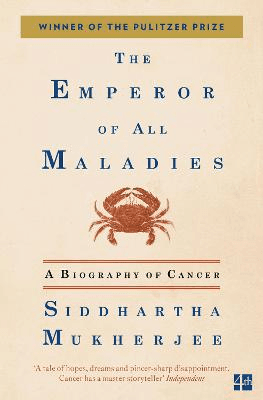
The Emperor of All Maladies
Siddhartha Mukherjee
In The Emperor of All Maladies, Siddhartha Mukherjee, doctor, researcher and award-winning science writer, examines cancer with a cellular biologist's precision, a historian's perspective, and a biographer's passion. The result is an astonishingly lucid and eloquent chronicle of a disease humans have lived with — and perished from — for more than five thousand years.The story of cancer is a story of human ingenuity, resilience and perseverance, but also of hubris, arrogance and misperception, all leveraged against a disease that, just three decades ago, was thought to be easily vanquished in an all-out "war against cancer." Mukherjee recounts centuries of discoveries, setbacks, victories and deaths, told through the eyes of predecessors and peers, training their wits against an infinitely resourceful adversary.From the Persian Queen Atossa, whose Greek slave cut off her malignant breast, to the nineteenth-century recipient of primitive radiation and chemotherapy, to Mukherjee's own leukemia patient, Carla, the book tells the story of the people who have soldiered through toxic, bruising, and draining regimes to survive and to increase the store of human knowledge.Riveting and magisterial, The Emperor of All Maladies provides a fascinating glimpse into the future of cancer treatments and a brilliant new perspective on the way doctors, scientists, philosophers and lay people have observed and understood the human body for millennia.EndorsementsWinner of the Guardian First Book Award 2011Winner of the Pulitzer Prize for Non-fiction 2011Shortlisted for the Duff Cooper Prize 2011Shortlisted for the Wellcome Trust Book Prize

Doughnut Economics
Kate Raworth
Economics is broken. It has failed to predict, let alone prevent, financial crises that have shaken the foundations of our societies. Its outdated theories have permitted a world in which extreme poverty persists while the wealth of the super-rich grows year on year. And its blind spots have led to policies that are degrading the living world on a scale that threatens all of our futures.Can it be fixed? In Doughnut Economics, Oxford academic Kate Raworth identifies seven critical ways in which mainstream economics has led us astray, and sets out a roadmap for bringing humanity into a sweet spot that meets the needs of all within the means of the planet. En route, she deconstructs the character of ‘rational economic man’ and explains what really makes us tick. She reveals how an obsession with equilibrium has left economists helpless when facing the boom and bust of the real-world economy. She highlights the dangers of ignoring the role of energy and nature’s resources – and the far-reaching implications for economic growth when we take them into account. And in the process, she creates a new, cutting-edge economic model that is fit for the 21st century – one in which a doughnut-shaped compass points the way to human progress.Ambitious, radical and rigorously argued, Doughnut Economics promises to reframe and redraw the future of economics for a new generation.Endorsements'I read this book with the excitement that the people of his day must have read John Maynard Keynes’s General Theory. It is brilliant, thrilling and revolutionary.' — George Monbiot'Brimming with creativity, Raworth reclaims economics from the dust of academia and puts it to the service of a better world.' — Tim Jackson, author of Prosperity Without Growth